
Two audiences, two navigation models
Information architecture and UX/UI for the Samsung Knox Partner Program, including two websites and a post-login dashboard, built in approximately six months.
THE CHALLENGE
A developer program serving business partners
The Samsung Enterprise Alliance Program (SEAP) provided technical resources and support to both developers and business partners. However it didn’t go far enough for partners wanting to take the next step. They needed more resources to build a deeper relationship with Samsung’s broader B2B business.
Its replacement, the Knox Partner Program was designed to bridge this gap, supporting partners and developers through the entire product life cycle. It provided not only technical resources, but tangible go-to-market support (sales channels, marketing resources) and ways to increase visibility within Samsung’s ecosystem.
My task was to create two new websites needed to introduce and explain the revamped program.
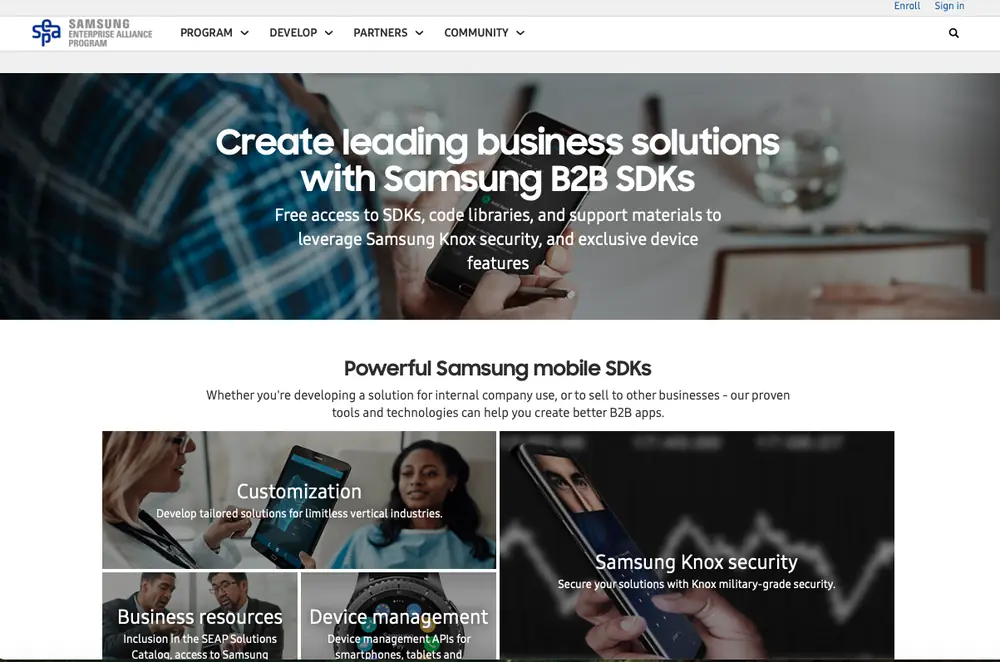
What I had to navigate
Tight timeline
Two websites plus a post-login dashboard in roughly six months, had to be completed against a fixed Samsung Developer Conference date.
Global, cross-functional team
While designing the UX, I navigated the complexities of a global team, balancing my workflow with the project manager (PM) and stakeholders in Vancouver and the HQ marketing team in Korea.
Vague requirements
Program details were still evolving while design was underway. Working with the marketing team and PM, I mapped out the user journeys for the developer and partner as a starting point.
Complicated technical content
The developer site housed SDKs, tools and technical documentation. I understand where to place that content inside the user journey.
HOW I APPROACHED IT
Tight timeline → set a direction and direct a team
I set the structural and design direction for both sites, leading a UX designer and a visual designer to execute cohesively under a highly rigid conference deadline.
Global, cross-functional team → in-person alignment and weekly meetings
I flew to Korea for a two-day workshop with the HQ marketing team, along with my UX manager and PM from Vancouver. There we worked through program strategy and information architecture in person, establishing a shared direction. We built on that through weekly syncs with Korea and regular in-office discussions with Vancouver team.
Vague requirements → Information architecture (IA) from content inventory
Rather than guessing at structure based on assumptions about each audience, I built the IA from a content inventory, studying the material and talking to the technical writing team to better understand it. That gave me an informed starting structure to test a task-approach against an audience-based one.
I then worked with the user researcher to validate the direction:
- Proposed program benefits/requirements with current partners
- Mega nav for partner and developer users
Below is an early pass at the partner site structure. The research results helped clarify the direction and I iterated based on the feedback.
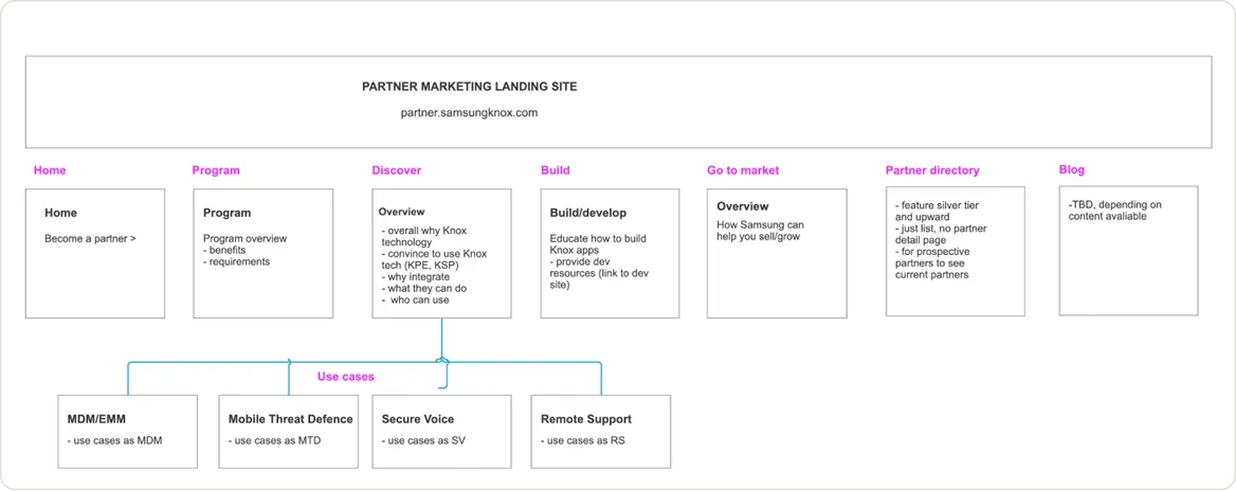
Partner
partner.samsungknox.com
- Program
- About Knox
- Build
- Go to Market
Orients first, then follows the journey. Program and About Knox explain what this is; Build and Go to Market follow the arc of the relationship.
Developer
developer.samsungknox.com
- Tools
- Documentation
- Developer Forum
- Blog
Organised by resource type. A developer isn't browsing a journey, but is looking for specific documentation and the shortest path to it.
Complicated technical content → framing SDKs as tasks
I consulted with the technical writing and marketing team to understand the content about the Knox SDKs and tools, and frame it in a less abstract way.
For example, task-based categories like security and manageability, firmware control and mobile enrollment established context, rather than just relying on technical product names like Knox E-FOTA.
WHAT SHIPPED
Launched at the Samsung Developer Conference (SDC), October 2019
The sites, partner.samsungknox.com and developer.samsungknox.com launched smoothly for SDC. Today, they continue to evolve and support their audiences, with elements of the site I worked on still remaining.