
Integrating AI-powered writing into clinical workflows
Designed an AI-assisted writing tool built directly into a clinical EMR so physicians could get the drafting help they were already seeking elsewhere, without sending patient data outside a secure system.
The Challenge
- Physicians are under pressure from time-consuming administrative documentation (e.g. referral letters, encounter notes, and paperwork).
- Although AI can help draft content faster, the current approach breaks the in-system workflow because it requires leaving CHR.
- External AI use is also limited by patient privacy requirements, restricting available patient context.
Constraints
- The feature had to live inside existing encounter and letter workflows, with minimal new screens or context-switches for an already time-pressed user.
- Clinics already relied on an existing template and variable system for letters - AI had to slot into that mental model, not introduce a second one.
Designing the Solution
To guide my designs, I participated in six physician interviews led by the product manager, and incorporated their insights. I designed around the rule: AI can generate but every AI action produces a distinct, reviewable draft that the clinician must explicitly accept, edit, or discard.
Prototyping process
Using Figma Make & Google AI Studio
I used Figma Make and Google AI Studio to prototype interactions, like how generated content should behave in real workflows. Iterating quickly on these prototypes with the PM helped define final features and design decisions. These explorations were also useful when discussing technical feasibility with developers.
Feature 01
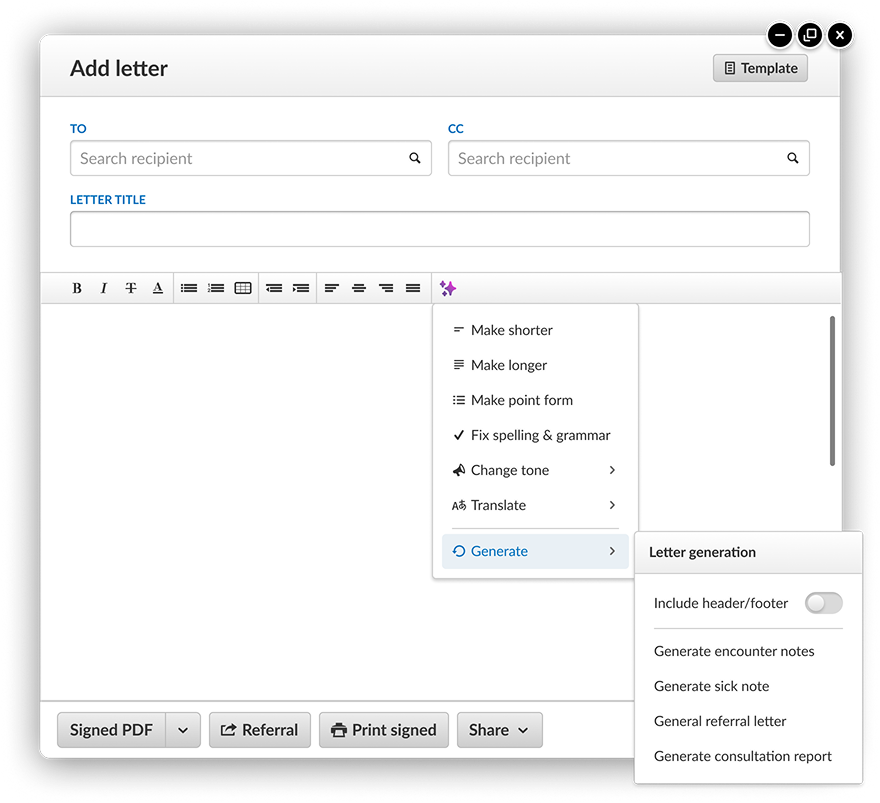
In-line AI writing tool
A contextual assistant that lives in the existing formatting toolbar of every encounter note and letter, so there's no new surface to learn.
Design details
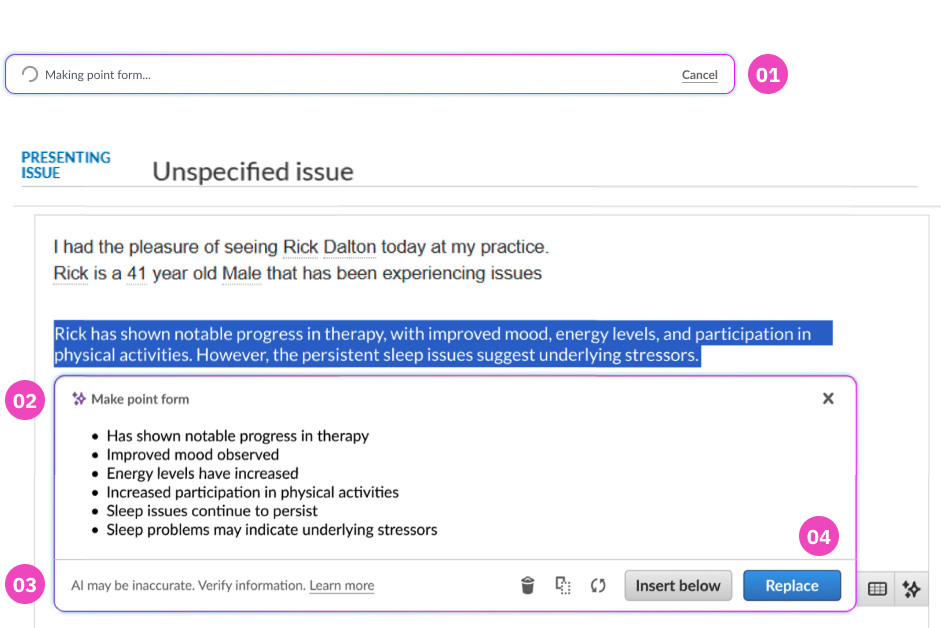
User can cancel the prompt mid-stream at any point during text generation.
Remind the user what prompt they selected originally to maintain design context.
Inform the user of limitations and risks of using the AI model, prompting critical verification.
Allows users to explicitly confirm AI actions before changes persist in the database.
Key design decision
Generated text opens in a visually distinct 'AI writing' panel below the field - never overwriting the original directly. The clinician chooses to insert, replace, regenerate, or discard. This made the trust boundary visible: AI proposes, the clinician decides.
I also explored other iterations where the panel was located outside the letter modal but it felt more disconnected. It was important that the user didn't lose context and understood where/what they were editing. Furthermore, discussing with developers, deemed this proposal not technically feasible anyway for the MVP.
Feature 02
AI letter variable templates
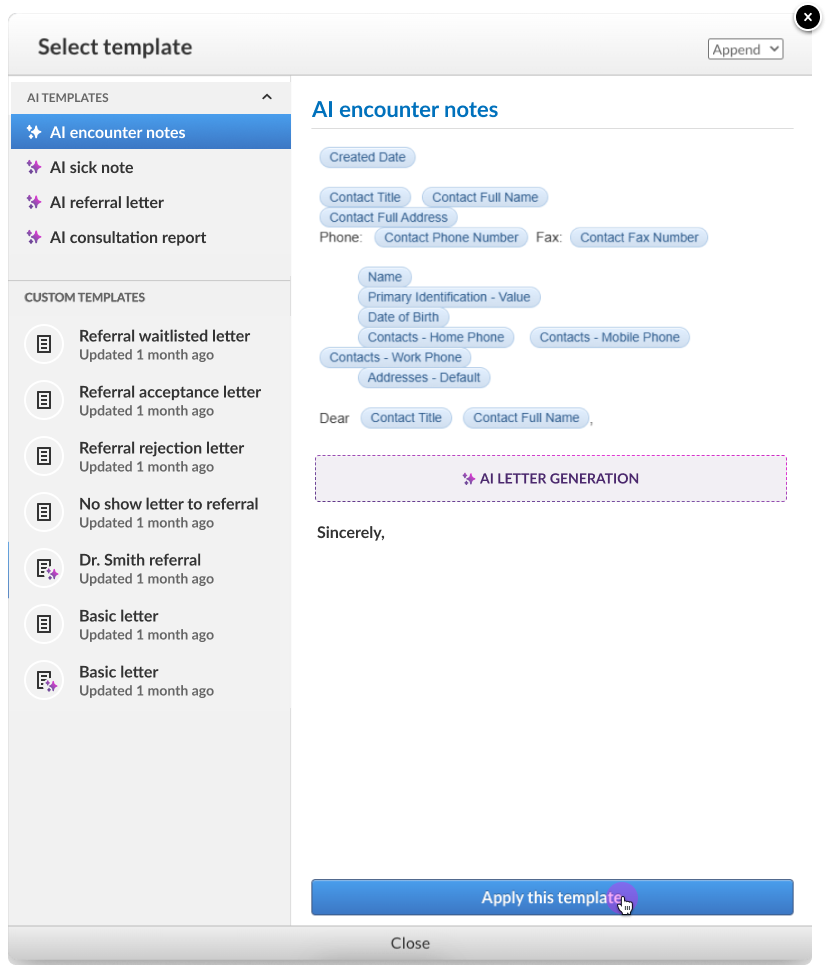
Many clinics rely on templates to write recurring letters, so it was essential to enable AI integration into their workflows. This feature lets admins create a reusable template once, including custom instructions for tone and structure, and then automatically generates the letter each time the template is applied.
Design decision
A key design decision was making a preview-and-regenerate step part of the AI template workflow. It let template authors verify the output of their instructions before saving, reducing guesswork and increasing confidence.
Impact
Shipped to production01
Physicians got the same drafting speed they'd already found valuable in outside tools without disrupting their workflow by leaving the CHR.
02
Removed a compliance gap the research surfaced directly: patient data no longer had to leave CHR's controlled environment for AI drafting help.
03
Gave clinics a way to configure and reuse their own AI-powered letter types through templates. Fit into their existing workflows and reduced manual drafting effort.
Usage metrics weren't available to me at the time of writing this case study. The points above reflect what the design solved for, based on research findings and constraints at the time.